 |
| Ghettos |
 |
| Rzeszów Ghetto
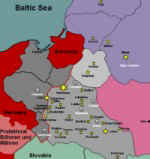
Map |
The city of Rzeszów, known to its Jewish
population as "Reishe", lies in the southeast of Poland, about 150 km east of
Krakow. Jewish settlement in the city had
begun in the 15th century and had steadily grown, until on the outbreak of WW2
the Jews of Rzeszów numbered 15,000, more than one-third of the total
population. The first German bombs fell on the city on
6
September 1939, and Rzeszów was occupied by the German Army four days
later. Jews attempted to flee eastwards to escape the invaders; according to
different sources 1,200–7,000 people fled the city (the latter number may have
included some refugees from neighbouring villages). Many were caught and turned
back.
German persecution of the Jews began almost immediately. Upon
entering the city, German troops were friendly towards the inhabitants, handing
out cigarettes and sweets. Five days later, at the time of the Jewish high
holidays of Rosh Hashanah (New Year) and Yom Kippur (Day of Atonement), Jewish
men still wearing their prayer shawls were driven from the city's synagogues
towards the River Wislok, where many were either drowned or beaten to death.
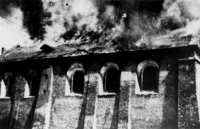
In
late September most synagogues were destroyed.
Jews were forced to clean the
streets. Then the old Jewish
cemetery, located near the centre of
the city, was demolished. Jews had to pull down the cemetery walls, break up all
tombstones and pave the roads with the rubble. The emptied area served later as
the
Sammelplatz for the deportees.
The city was incorporated in the
Generalgouvernement. In
October a
Judenrat was appointed, headed by Dr
Kleinmann. The
Ordnungdienst, the Jewish
police, was formed, initially numbering 25 functionaries and headed by a former
Polish officer from
Lodz,
Gorelik. On
26 October,
an edict, issued by
Hans
Frank, required all Jewish males between the ages of 14 and 60 to
register for work. Soon Jews were summoned for forced
labour
. With effect from
1 December 1939, all Jews in the
Generalgouvernement
were ordered by
Frank to wear on their right
arm a white band at least 10 cm wide, bearing a Star of David. Jewish shops had to be
marked
with the Jewish star. By the
end of 1939, there were 10 forced labour camps in the
Rzeszów region. The military airport to the north of the city became the main
workplace for Jewish slave labourers in the region.
In
May 1940 Jewish apartments were confiscated, and Jews were
prohibited
from using the city's main thoroughfares, Trzeciego
Maja and
Zamkowa Streets. Later the
all night curfew
was introduced. All Jewish men had to report at
the
Arbeitsamt.
In
1940, several
hundred Jews from Rzeszów were sent to camps which had been established in
Pustkow (near
Debica),
Jaroslaw and
Lipie (near
Nowy Sacz).
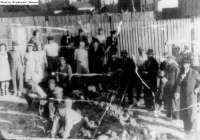 |
| Jews engaged in forced
Labour |
 |
| Hans Mack |
In the first days of
January 1940, a new
Kreishauptmann (District
Leader) was appointed,
SS-Sturmbannführer Dr
Heinz
Ehaus, who was known as a persecutor of both Jews and Poles in
Nisko, where he served as a
Landkommissar
from
30 September 1939. The
Kommissar of the
town was Dr
Hueller and the
Gestapo
chief was
Hans Mack. The
Judenreferat
(Jewish section) of the
Gestapo was headed by
Adolf Schuster; his deputies were
Clemenz Burmester and
Kurt
Dannenberg. The
Gestapo appointed succeeding commandants of
the Rzeszów ghetto –
SS-Hauptscharführer Bacher,
SS-Oberscharführer Kurt Schupke, (who had earlier served at
KZ Buchenwald and who was later, in
September 1944, appointed commandant of KZ Plaszow),
and
SS-Unterscharführer Georg Oester.
In
January 1940,
Kleinmann and other members of the
Judenrat
were executed at the marketplace for failing to provide a sufficient number of
forced labourers (according to the
Ringelblum
archive);
Benno (Bernard) Kahana, Kleinmann’s
deputy, was appointed head of the new
Judenrat.
Between December 1939 and January 1940, 6,000–7,000 Jews
were deported to Rzeszów from the
Warthegau and Upper Silesia, among them
1,800 Jews from
Lodz and 1,224 from
Kalisz. There were also 630 émigrés from Germany who
had arrived in
1938 - 1939. In turn, several thousand
Jews, both residents of the city and refugees, left Rzeszów and made their way
to
Warsaw, to Soviet-occupied Poland or to
other places in the
Generalgouvernement. Later, only a handful managed to
cross the border legally. The deadline for the exchange of refugees between
Germany and the Soviet Union was set for
15 May 1940.
An order of the
RSHA dated
25 October 1940,
banned all Jewish emigration from the
Generalgouvernement.
By
June 1940, the number of Jews in Rzeszów had decreased to
11,800, of whom 7,800 were pre-war residents of the city. At the same time, the
number of Jews in the towns and villages of the Rzeszów region were (with the
number of refugees in brackets):
Blazowa – 931
(139),
Czudec 428 (33),
Głogów M. – 806 (87),
Kolbuszowa – 1,427 (700),
Lancut – 900 (502),
Niebylec – 570 (20),
Ranizow – 620 (63),
Sedziszow – 110 (81),
Sokolow
M. – 1,700 (186),
Strzyzow – 1,238
(174),
Tyczyn – 500 (140),
Zolynia – 700 (103),
Lezajsk – (500).
 |
| Albert Pavlu |
On
17
February 1941, the city was renamed
Reichshof. Rzeszów became home to an important factory
complex for the production of aircraft engines. Resettlement of Jews to
the future ghetto began from
June 1941. The ghetto
area was surrounded by 3 m high wooden fences and walls. Entrances and gates
remained open. A new
Stadtkommissar was appointed, a Nazi
fanatic,
Albert Pavlu, who personally killed a
number of Jews even before the deportations started. In
December 1941, Jews had to hand over
all furs
and fur collars.
The
witness
Samuel
Isak Wilf, testified:
"
The ghetto was not
established until 10 January 1942. Posters appeared,
stating that within 3 to 5 days all Jews had to move into the houses reserved
for the ghetto. At that time only the Jews from Rzeszów lived in the ghetto,
plus about 2,000 refugees from Lodz etc. The
Jews from the surrounding area were left in peace for the time being. Originally
the ghetto was big, containing about 20% of the town. Nevertheless, some houses
were really crowded, with up to 20 persons in one room. Within the wooden fence
around the ghetto 3 gateways were set, guarded by Jewish and Polish police. Only
those with a job outside the ghetto were entitled to leave. However ... could
bring in some food, so that at first we did not starve."
On
17 December 1941 a decree was issued, establishing a ghetto
in Rzeszów, and on
10 January 1942 the ghetto area
was closed off, imprisoning approximately 12,200 Jews, more than 3,000 of them
refugees and people deported from western Poland. Overcrowding, starvation and
lack of hygienic facilities resulted in the inevitable epidemics, in which
hundreds died. In
March 1942, the
Gestapo
murdered residents of two houses in the ghetto. On
30 April
1942, the
Gestapo murdered another 35 people in the ghetto. They
were taken from their homes and shot. On
12 May, 250
Jews from the Rzeszów prison were taken to the
Nowa Wies
forest, shot, and buried.
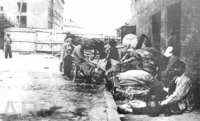 |
| Resettled Jews |
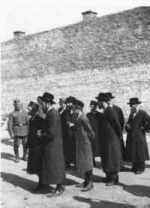 |
| Jews in Rzeszów |
The process of concentrating the Jewish
population of the region started as early as
March
1941. All the Jews from small villages were ordered to move to ghettos in
the nearest towns. They had to leave behind almost all their property. Jews
moving to the
Tyczyn ghetto were brutally
beaten; all were robbed, a number killed. On
25-27
June, all
Tyczyn Jews were resettled to
the Rzeszów ghetto. Again, the march was accompanied by brutality and murders. A
number of
Tyczyn Jews were executed at the
local Jewish cemetery. Jews living near
Kolbuszowa were forced into the ghetto there in
autumn 1941.
This ghetto was closed in
February 1942. In
Sokolow
Malopolski the ghetto was formed in
April
1942. At the time of the ghetto's liquidation in
June
1942, 3,000 lived there. During the resettlement to Rzeszów 28 persons
were killed. Most of the Jews from the ghetto in
Głogów
Malopolski were moved to Rzeszów in
early July
1942. A number were executed at the
Głogów forest
(
Rudna Forest), situated between Rzeszów and
Głogów. Jews, concentrated in the
Strzyzow ghetto, were resettled to Rzeszów on
26 April and 9 June, those from
Blazowa on
26 June.
By the
end of June 1942, all Jews from the
smaller towns of
Majdan Kolbuszowski, Czudec,
Niebylec, and
Staniszewska,
together with some from
Lancut, Sedziszow
Malopolski, and from small villages near Rzeszów were forced into the
Rzeszów ghetto. As a result, the population of the ghetto rose to almost 23,000.
In
June 1942, the responsibility for the entire
Jewish population was transferred from the administrative authorities to the
Police and SD. At the beginning of July, the Germans imposed a penalty on the Rzeszów
ghetto of 1,000,000 zlotys, to be paid by its inhabitants.
The
witness Samuel
Isak Wilf, testified:
“
Afterwards the
compulsory labour regulations were tightened up. Most Jews were forced to work.
Around the same time came the "contributions". First 2, then another 3, then a
further 7 million zlotys, and finally the delivery of all money. The Jews had to
pay all tax arrears. Aryans who held claims against Jews were entitled to get
paid without delay. Eventually the order came that all Jews from the surrounding
area had to move into the town of Rzeszów. Many fled into the forests, but some
11,000 obeyed, so that the ghetto suddenly had some 24,000 inhabitants.”
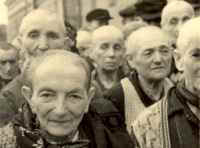 |
| Elderly People, in 1942 |
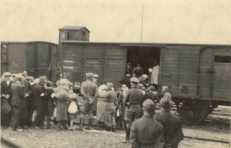 |
| At Staroniwa Station |
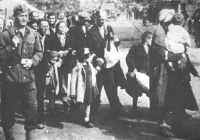
Between 7 and 19 July 1942, the first
deportation
Aktion occurred. In the early morning of the
7 July, residents of the southern section of the ghetto had
to gather in the
Sammelplatz (the former Jewish cemetery). Here they
underwent a selection. Those chosen for work, i.e. life, were given special
seals on their work cards. A large detachment of police
entered the ghetto. 2,000 mainly elderly and sick Jews were taken to the nearby
Głogów
forest, and shot there. A group of Jews
was sent to the
Flugmotorenwerk at
Lisia
Gora. 4,000 Jews were marched to
Staroniwa
station, packed 100–120 people in each of the cattle cars and
transported to
Belzec, where
they were gassed on arrival.
The march to the station on that day was
especially brutal. People were herded, beaten with rifle butts and shot on the
way, before the eyes of the local population (including German civilians, who
officially protested afterwards). 236 people were
shot
in the ghetto streets, 42 on the
way to the station. Jews who buried the bodies at the
Czekaj Jewish cemetery were also killed. Among the
executioners were
Pavlu and
Mack.
 |
| Deportation in Rzeszów |
The next transport to
Belzec left
Staroniwa
station on
10 July. After the selection at
the
Sammelplatz, 500 elderly people were taken to the
Głogów forest for execution. Following the protests
of local Germans, this time the march to the station was much less brutal.
Afterwards the
Judenrat was obliged to pay for the transports.
Two
other transports departed from
Staroniwa on
14 and 19 July. Sources differ in estimating the
total number of those deported at between 18,000 - 21,000. Since some 4,000 Jews
were still living in the ghetto after the July deportations, it may be assumed
that a figure of around 20,000 is accurate if this is to include the victims of
the mass executions in the
Głogów
forest and
those killed in the ghetto.
 |
| Heinz Ehaus |
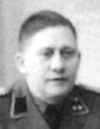
At the time of
deportations
Kreishauptmann Dr
Heinz
Ehaus dedicated a wooden eagle, inscribed: "This eagle, the German
sign of superiority and dignity, was put up to mark the liberation of the town
of
Reichshof of all Jews in the month of
July
1942. It was put up during the services of
Sturmbannführer Dr
Heinz Ehaus of the SS, first
Kreishauptmann and chief of the NSDAP for the district of
Reichshof." This eagle was placed in Rzeszów Castle, which housed the offices of the
Kreishauptmann, a court
and a prison.
The ghetto was subsequently reduced in size. At the
end of July a large group of Jews from the
Debica ghetto were brought to the Rzeszów Ghetto. On
7 August, a second
Aktion took place, in the
course of which approximately 1,000 women and children were taken to the
Pelkinie forced-labour and transit camp near
Jaroslaw in the
Lwow
district (there were already 10,000 Jews from
Lezajsk, Lancut, Zolynia, Radymno and other places
in this transit camp). After a brief stay, they too were transported to
Belzec.
On
25 October
1942, a group of 120 Jews from the liquidated
Głogów Malopolski ghetto were sent to the Rzeszów Ghetto. A third
Aktion was carried out on
15 November
1942. All Jews were gathered at the
Appellplatz at
Baldachowka Street, where a selection took place. A
further 2,000 Jews were sent to their deaths in
Belzec. During the course of this
Aktion, a
large force of Security Police under the command of
Paul
Lehmann searched the ghetto for children. Any found were killed on
the spot.
The witness Samuel Isak
Wilf, testified:
“
Around this time another
action was planned. The Jewish employment agency had summoned all unemployed
women and children unfit for work to be registered. A complete company of German
police had been hiding in the agency. The women and children were rounded up
immediately, their property was taken from them and they were deported to Belzec. There were also 4 men among these people,
three of whom were elderly and one a younger man named Holoschek who subsequently sent us a note from Belzec in which he wrote that he was working in
hell. At first we did not understand the message, but afterwards we heard that
his job was to assist at the burning of corpses. We also heard that some of the
women had to work on farms. Later we no longer received any messages. Probably
all of these people were killed."
Following this last
Aktion there were no more than 3,000 Jews left in the ghetto, which was
then reduced still further in size and divided into two separate camps. The
section east of
Baldachowka Street, called
"Camp A", became a
Jüdisches Zwangsarbeitslager (Forced-Labour Camp for
Jews). "Camp B", west of
Baldachowka Street,
housed the families of the forced labourers. Ghetto A was subordinated to the
Krakow office of
SSPF Scherner, not the Rzeszów police office. The first
commandant of the camp was
SS-Hauptscharführer Bacher, a sadist. Men and women were separated and
the camp was organized as a concentration camp. Some of the 2,000 prisoners
(those with a "W" badge) worked outside of the camp for different German Army
workshops. There was also an
Ostbahn” Group, working under a certain
Bremmer (or Brehmer). Some Jews laboured in
the ghetto workshops under the command of
Eintracht.
Bacher
served as the commandant until
March 1943, when,
after a conflict with the local
Gestapo, he was transferred to the
Szebnie camp. He was replaced by
SS-Hauptscharführer Kurt Schupke. The
ghetto B, or "West Ghetto" (called
Schmelzghetto / "Melting Ghetto"), was
subordinated to the Rzeszów
Gestapo and the
Judenrat still
functioned there. Family members of Ghetto A workers lived there as well as
deported newcomers. On
15 December a group of 600
Jews from the liquidated
Krosno Ghetto were
transported to Rzeszów and on
14 December, a group of
170 prisoners from the
Dukla work camp.
A
witness,
Hilde Huppert, who had been deported
to Rzeszów, described what she had seen in
February
1943:
"
I stood at the window and saw 20 miserable
figures wrapped in rags crouching in the lorry. I did not understand what it
meant and asked a native of Rzeszów to explain it to me. That, he said was an
incident which repeated itself every six weeks. A few weeks ago these people had
left Rzeszów hale and hearty. They were sent to the equipment workshop at Stalowa Wola, not far from Rzeszów, from which they
returned as living corpses. They had to work 18 hours a day under violent ill
treatment on a diet on which no one could live. When I asked why they brought
such sick people here, he explained that the factory only acquired healthy
bodies in exchange for the expended human material."
The 20 people
were put to bed in a room in the ghetto, but two days later:
"
Towards seven o'clock 6 Gestapo men arrived and asked to
see the sick workers... In the sick room they ordered the people to get up and
run into the square. Whoever could not run would be killed. They chased the poor
victims out of bed with blows of the whip and forced the ones who could hardly
stand on their feet to run to and fro. The executioners found it so funny that
they had to stop their mouths from laughing. Then they began to shoot at the
runners… As we reached the West Ghetto we stumbled into puddles of blood… We saw
corpses lying in front of our houses."
On
23
March 1943, more than 20 prisoners of the
Ostbahn Group were
executed. Soon the whole group was dissolved. At the same time a small group of
prisoners from
Biesiadka camp (a lumber works)
returned to the ghetto. In subsequent months most prisoners of the ZAL (Ghetto
A) in Rzeszów were transferred to other camps, mostly to
Szebnie near
Jaslo, and to
Stalowa
Wola. On
23 July 1943, when the latter
camp was evacuated to
KZ Plaszow, there were
416 prisoners, including 50 Jews from Rzeszów. An unknown number of Jews were
sent to
Debie sub-camp, where most probably
all were killed. 110 Rzeszów prisoners were transported to
Pustkow camp and, upon its liquidation, to
Auschwitz
and still further to
KZ Mauthausen and
KZ Gusen. A group of Jews from the
Flugmotorenwerk at
Lisia Gora, among
them 30 originating from the Rzeszów Ghetto, were evacuated to
Plaszow. Some 60 Jews from
Huta Komorowska sub camp (a lumber works) were
brought to Rzeszów and executed there. The rest of the
Huta Komorowska workers were executed in the
Głogów forest in the
summer of
1943.
On
4 September 1943, most
inmates of Camp A were moved to the
Szebnie forced-labour
camp near
Jaslo, 129 km southeast
of
Auschwitz. In
early
November, some 700 of these prisoners were taken to a forest near the
village of
Dobrucowa and shot. The last major
group (ca. 2,800 Jews) was transferred to
Auschwitz on
3 November
1943, where most of them perished. On
6
November, 500 Jews were killed in
Szebnie and upon the liquidation of the camp, on
30 December 1943, the last 84 Jews were transported
to
Plaszow along with 1,000 Poles. Those
incarcerated in Camp B in Rzeszów were transported in
November to
Auschwitz-Birkenau and gassed.
One of the
survivors of the
6 November Massacre in
Szebnie was
Lotka
Goldberg, who managed to reach the Rzeszów Ghetto. She was greeted by
the "liquidation party", headed by the chief of the
Jüdischer
Ordnungsdienst (Jewish police)
Gorelik and
camp commandant
Schupke, who said that she
deserved the Iron Cross First Class for her escape.
Gorelik tried to organise escapes, but he was caught
by the
Gestapo, tortured and killed.
Lotka
Goldberg was among a group of 36 Jews, who hid in a bunker dug within
the ancient tunnels of Rzeszów Old Town. Only 6 of these fugitives survived when
the bunker was destroyed.
Lotka Goldberg was
captured in another hiding place and transported to
Plaszow. On
14 January
1945, she marched from
Plaszow to
Auschwitz, finally arriving at the
KZ Bergen-Belsen, where she was liberated by the
British Army.
 |
| Burning Synagogue, in 1944
|
By
July 1944, there were only about 600 prisoners left in Camp
A. A few managed to escape and hide in nearby forests until the area was
liberated by the Red Army the following month. The remaining prisoners in Camp A
were transferred to
Auschwitz, where most of
them died.
The last commandant of the camp
Flugmotorenwerk at
Lisia Gora was
Georg
Oester, a man noted for his previous brutal behaviour in the ghetto.
As the Red Army approached in the
summer of 1944, the
factory was dismantled and the machinery sent to Germany. However, before the
prisoners could be liberated, they were transferred to
Plaszow, where they once again encountered
Schupke, this time as the commandant of the camp.
After about a week they were sent to
KZ
Flossenbürg and from there to a factory at
Orbis, near the French city of
Mulhouse. Because the Allies were advancing from the
West, the prisoners were taken to
KZ
Sachsenhausen, where the group was broken up and sent to various
camps in Germany. By the war's end, of the original contingent of about 600 Rzeszów
Jews, only a few dozen of them had survived (see Samuel Wilf's
story.).
Schupke escorted the last
group of 500
Plaszow Jews to
Auschwitz, on
17 January
1945.
The
1944 edition of Baedeker's
"Generalgouvernement Guidebook" describes Rzeszów, known in the
mid-19th century as "Little Jerusalem", as a city "formerly
dominated by numerous Jews." Of 15,000 Rzeszów Jews, merely 100 survived the
war; in Rzeszów itself, in hiding all over Poland, and in various camps. After
the war an additional 600 Rzeszów Jews returned from the Soviet Union. Almost
all of them subsequently left the city and the country.
Schupke, commandant of the eastern ghetto (A), later
Jüdisches Zwangsarbeitslager (ZAL) and the last commandant of the
Plaszow camp, was sentenced to death by the
Krakow District Court, and hanged on
27 November 1948.
Some other defendants accused of
crimes in the Rzeszów area either received modest sentences or were acquitted.
Other Trials: Kiel,
1966, Flensburg,
1963: Fellenz,
Martin - 7 years
(
Polizei SSPF Krakow)
Crimes committed in
Krakow, Michalowice, Miechow, Przemysl, Rzeszów,
Tarnow,
June 1942 - August 1942
Subject of the proceeding: Deportation of the Jewish population of
Krakow, Miechow, Przemysl, Rzeszów and Tarnow to
KL Belzec. Shooting of Jews, who were in no
condition to be transported or who were unable march. Shooting of fleeing or
“obstinate” Jews from the town of
Michalowice
during their deportation to the
Slomniki
Ghetto.
Berlin (DDR),
1968: Zimmermann,
Rudolf - life sentence
(
Gestapo Mielec,
Gestapo
Stalowa Wola,
Gestapo Rzeszów)
Crimes committed in
Baranow-Sandomierski, Borowa, Charzewice, Krzemjenica, Mielec,
Radomysl-Wielki, Rzeszów, Rozwadow, Stalowa Wola, Berdechow forest (near
Mielec), Wolka-pod-Lasem, Forced Labour Camp Mielec;
Jan 1941 – May 1943.
Participation, as translator and
Gestapo employee, in the shooting of hostages, in the deportation and
selection of Jews, in individual and mass shootings and in acts of mishandling
and statement extortion. In this way the accused took part in the murder of, at
least, 1,239 Polish civilians, in the mishandling of 85 civilians in the course
of interrogations and in the deportation of at least, 7,100 Jews. He killed 106
Jews single-handedly.
Memmingen,
1970: Dannenberg,
Kurt - acquittal;
Lehmann, Paul
- acquittal;
Oester, Georg - life
sentence;
Schuster, Adolf - 5 years
(
Police Sipo Rzeszów)
Crimes committed in Rzeszów, HS
ZAL
Flugmotorenwerke Reichshof, in years
1942 - 1944
Group- and single shootings of Jews from
ZAL Flugmotorenwerke
Reichshof and Ghetto Rzeszów. Participation on
Aussiedlungsaktionen.
Shooting of Jews who have been in hiding after the liquidation of the ghetto.
Shooting of typhus-ill Jews at the ghetto hospital, of in the Rzeszów prison
imprisoned Jews, as well as a group of 27 Jews who were accused of having bribed
an
Ostbahn officer.
Photos:
Stanislaw Kotula,
Losy
Zydów Rzeszówskich Collection of the
Jewish Historical Institute ZIH
Sources:
1) Gutman, Israel, ed.
Encyclopedia of the
Holocaust, Macmillan Publishing Company, New York, 1990
2) Hilberg,
Raul.
The Destruction of the European Jews, Yale University Press, New
Haven, 2003
3) Gilbert Martin.
The Holocaust – The Jewish Tragedy,
William Collins Sons & Co. Limited, London, 1986
4) Gilbert, Martin.
Holocaust Journey, Weidenfeld & Nicolson, London,1997
5) Arad
Yitzhak, Gutman Israel and Margaliot Abraham, eds.
Documents On The
Holocaust, University of Nebraska Press, Lincoln and London, 1999
6)
Justiz und NS-Verbrechen: http://www1.jur.uva.nl/junsv/index.htm
7)
Reitlinger, Gerald.
The Final Solution – The Attempt to Exterminate the Jews
of Europe 1939-1945, Jason Aronson Inc, Northvale, New Jersey and London,
1987
8) Poradowski, Stanislaw.
Zaglada Zydow Rzeszówskich – Extinction of
Rzeszów Jewry, Biuletyn ZIH, 1984-93.
9) Kotula Stanislaw.
Losy Zydów
Rzeszówskich 1939-1944. Kronika tamtych dni (The Fates of the Rzeszów Jews. A
Chronicle of those Days), Rzeszów 1999.
10) Salton, George Lucius.
A
Holocaust Memoir, The University of Wisconsin Press, Madison, 2002
© ARC 2005
